Miju Labs

Live · 420 accounts · 5607 posts archived

The feed

What the field is saying, as it says it. Every public post from the companies and people this atlas tracks, on X and LinkedIn, in one timeline. Click any company to open its people.

Anthropic used CyScenarioBench, our benchmark for multi-stage offensive cyber operations, in the cyber evaluations for Claude Opus 5.5. Across a ten-challenge subset, Opus 5.5 averaged a 67.6% solve rate, ahead of Claude Mythos 5.1 at 61.7% and Claude Opus 5 at 53.0%. Full write-up in the first comment.
Canada is where Cohere was born. It's the place that raised us, gave our founders an education, and taught them the values with which we build our technology. Those values? AI shouldn't take you away from the things you love. AI should empower you to spend more time with them.
Cursor@cursor_ai·
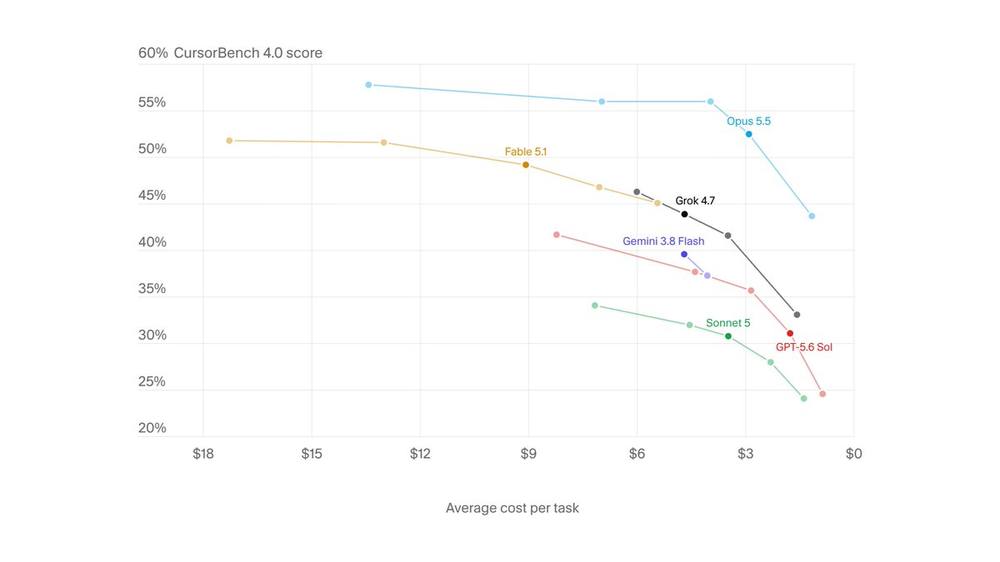
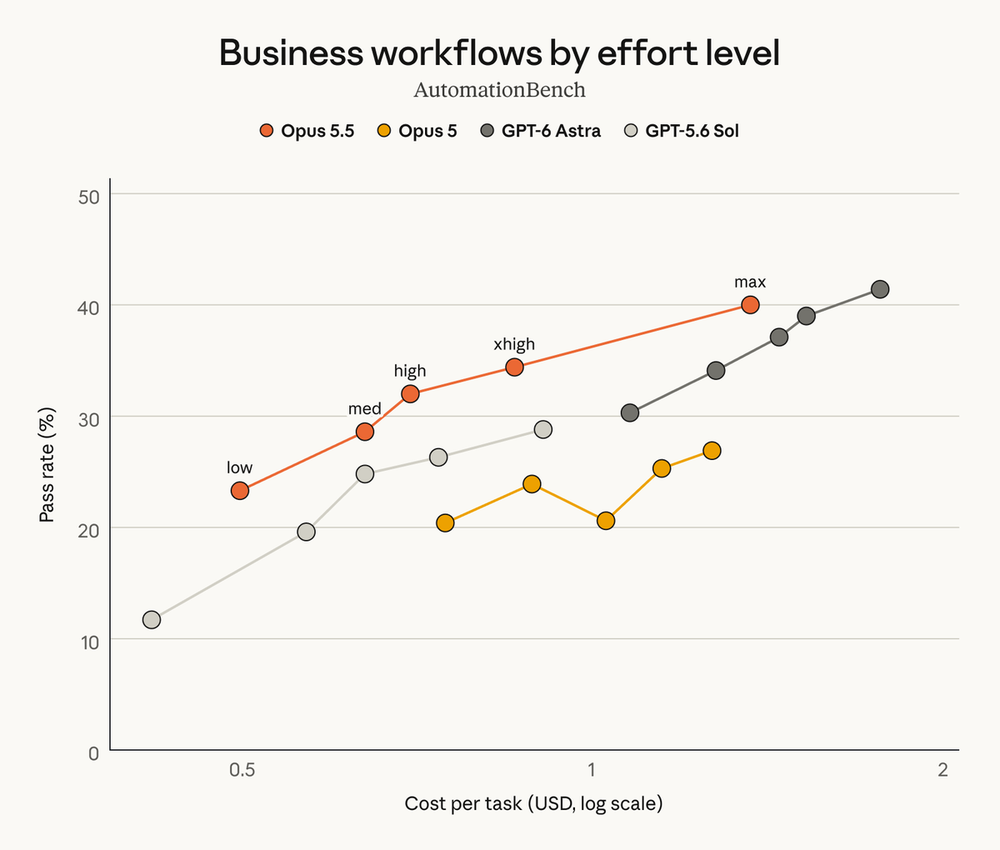
Claude Opus 5.5 is now available in Cursor! It's the new top model on CursorBench at 57.8% (Max) and costs 40% less per task than Opus 5.
475160122KView on X ↗
Snorkel AI reposted this
Saam Motamedi
Partner at Greylock Partners
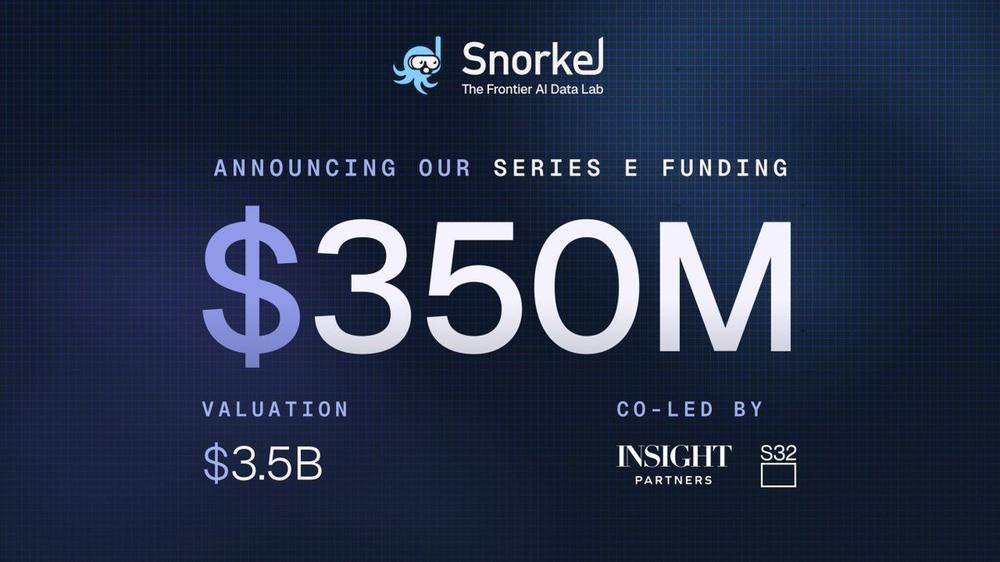
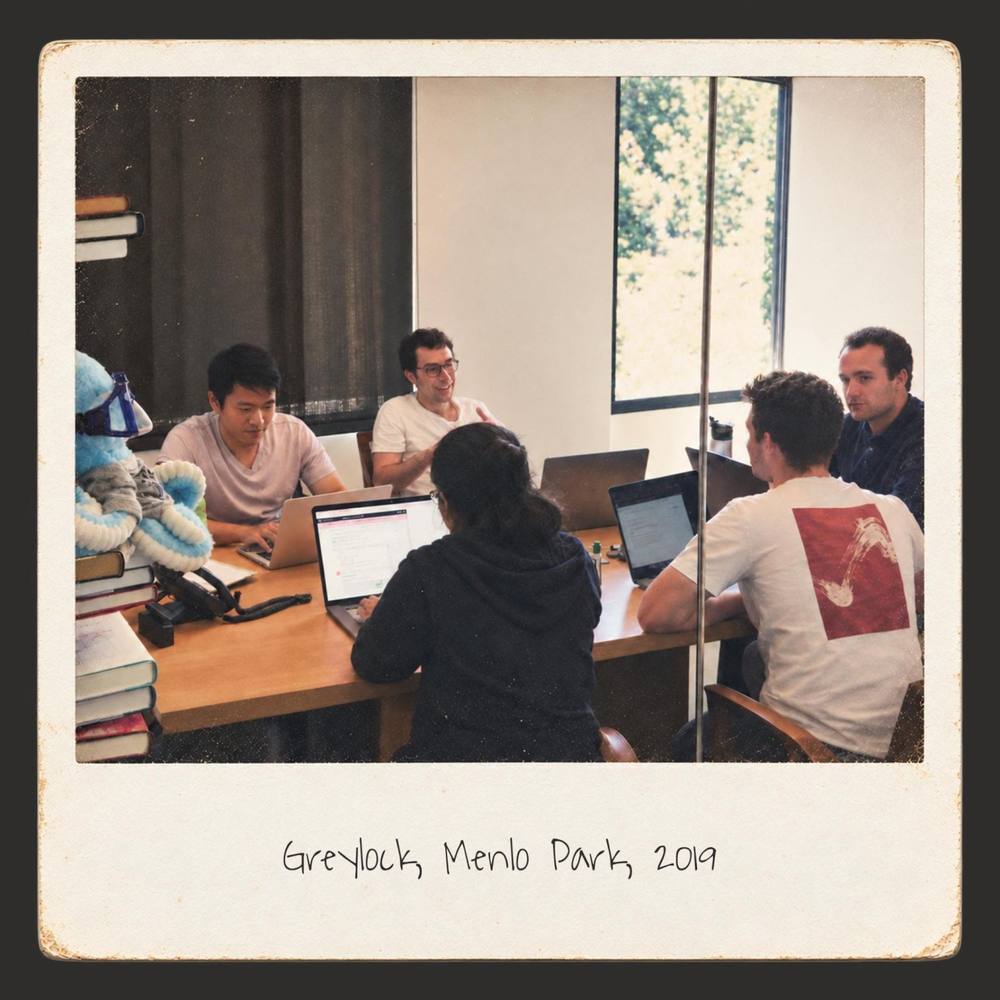
Excited for Snorkel AI to announce that they have raised $350M at a $3.5B valuation and have crossed $375M in annual revenue run rate. While AI has changed dramatically since Snorkel was founded in 2019 and we at Greylock Partners led their Seed and Series A, Alexander Ratner and team have been consistent in their belief that data is the very core of AI. Spending years at Stanford, and then at Snorkel, pioneering a different approach to data: treating it as a product and technology problem, combining expert knowledge with deep technology to drive much higher quality data, significant technology leverage, and very attractive unit economics. Snorkel's approach is powering the agentic and RSI wave across the frontier labs, applied AI companies and large enterprises. On a personal note, I couldn't be more proud of Alex. He has navigated an industry that evolves at an extraordinary pace while maintaining unwavering focus on the company's north star and building tremendous business momentum. He is a very special leader. And as a fun relic of history: a photo of the original Snorkel team when they just got started building out of Greylock's Menlo Park office :) cc Greylock Partners, Paroma Varma, Henry Kiss Ehrenberg, Braden Hancock, Chris Re, Vincent Sunn Chen, Anand Raghavan, Jimmy Hillis, Raviraj Jain, Ravi Mhatre, Todd Arfman, Aaron Schildkrout
466 comments • 4 reposts
As part of our efforts to pace the frontier, we’re committed to supporting independent assessments with deep levels of access across training, evaluation, and deployment. That access should enable third party assessors to challenge our assumptions, identify risks we may have missed, and reach their own conclusions about the effectiveness of our safeguards. We’re outlining four priority areas for deeper assessment, alongside principles for rigorous, secure, and independent work: openai.com/index/priorities-prin…
2731271.4K120KView on X ↗
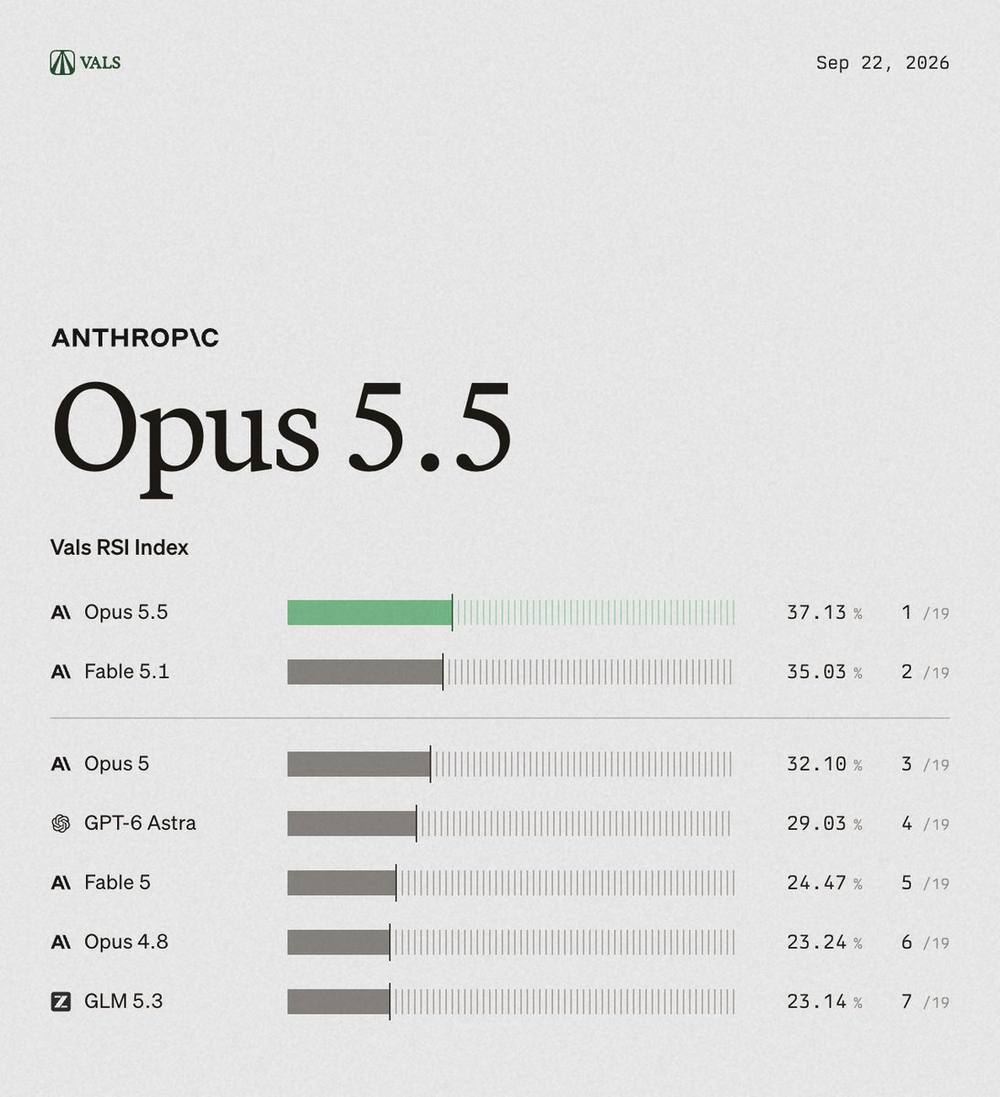
Claude Opus 5.5 takes #1 on RSI Index and is the first model to beat the published reference on LM Training under our protocol, marking a major step forward for long-horizon agentic work.
8141497.4KView on X ↗
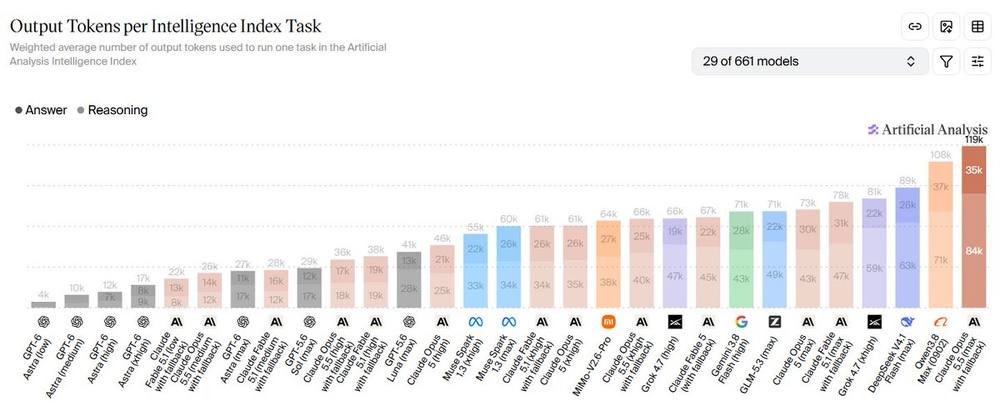
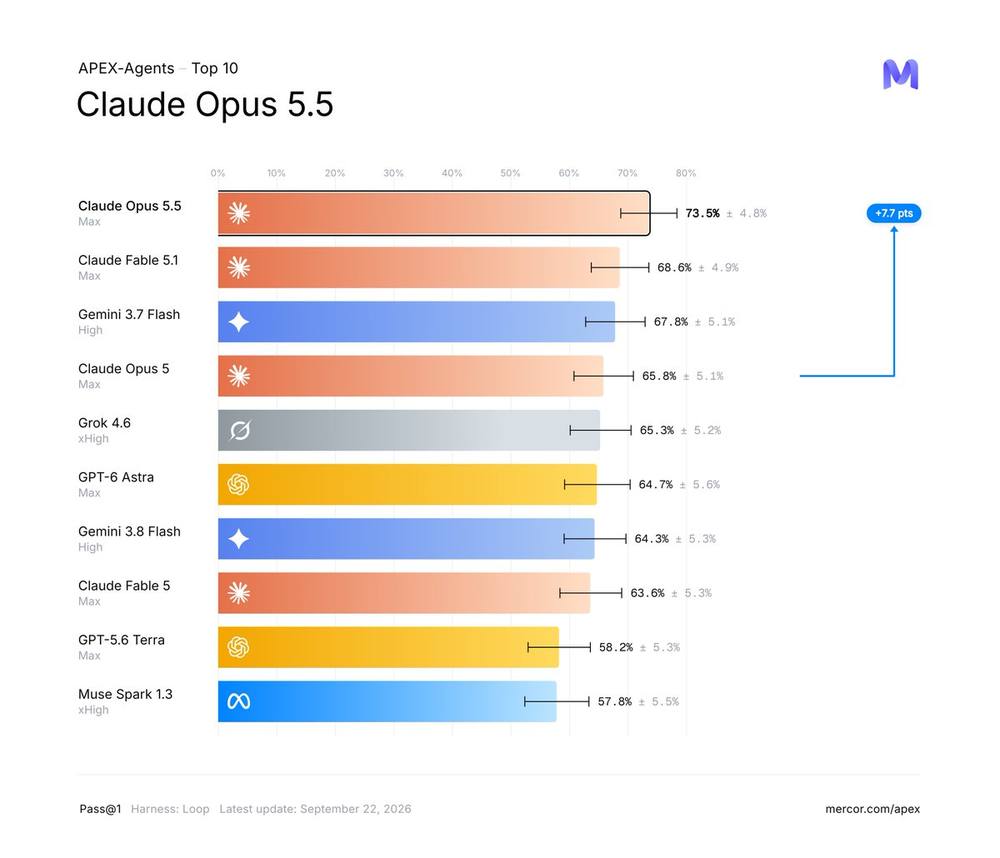
Claude Opus 5.5 is the new #1 on APEX-Agents and APEX-Accounting. APEX-Agents: 73.5% Pass@1 (#1) 81.3% mean score (#1) APEX-Accounting: 15.4% Pass@1 (#1) 62.0% mean score (#1) On APEX-Agents, the new model gains +4.9 pp over Fable 5.1 (68.6%), the previous leader, and +7.6 pp over Opus 5 (65.8%). Anthropic says the biggest gains in this release are on long-running agentic tasks and knowledge work. That is what APEX-Agents measures, and the numbers agree. Opus 5.5 on APEX domains: Management Consulting: 80.0% Pass@1 (#1) Corporate Law: 71.2% Pass@1 (#3) Investment Banking: 69.3% Pass@1 (#2) Accounting: 62.0% mean score (#1) Token use can indicate domains where the model is most effective. Consulting leads at 80% and uses the fewest tokens at 2.0M per attempt. Law has the highest partial credit (85.7% mean) but costs the most at 4.9M tokens. In Accounting, Opus 5.5 gets partial credit on most tasks but fully passes only 1 in 6. More tokens can increase capability on Opus 5.5. Max effort consumes 3.50M tokens per attempt. That’s 2.1x more than Opus 5 and 1.2x Fable 5.1. But list price fell to $4/$20 per M (Opus 5 was $5/$25), and cache reads are $0.20, so 2.1x the tokens is only about 1.7x the dollars. Effort level has a significant impact on benchmark scores and token usage. Medium effort: 52.3% on 756k tokens Max effort: 73.4% on 3.50M tokens Increasing effort to max gains 21 points for 4.6x the tokens on agentic work. On APEX-Accounting, the same jump buys 2.8 points for 3.4x the tokens. When Opus 5.5 solves a task, it solves it consistently. 142 of 239 tasks passed on all 4 runs. Failing runs used 3.1M tokens vs 1.9M for passing runs, and took twice as long. 13 runs hit a hard failure, all in Corporate Law. 8 of them burned 25M to 42M tokens before dying, showing that long-horizon legal work can still send the model into a loop. Congratulations to the @claudeai team. See full leaderboard: mercor.com/apex/apex-agents-lead…
Perplexity@perplexity_ai·
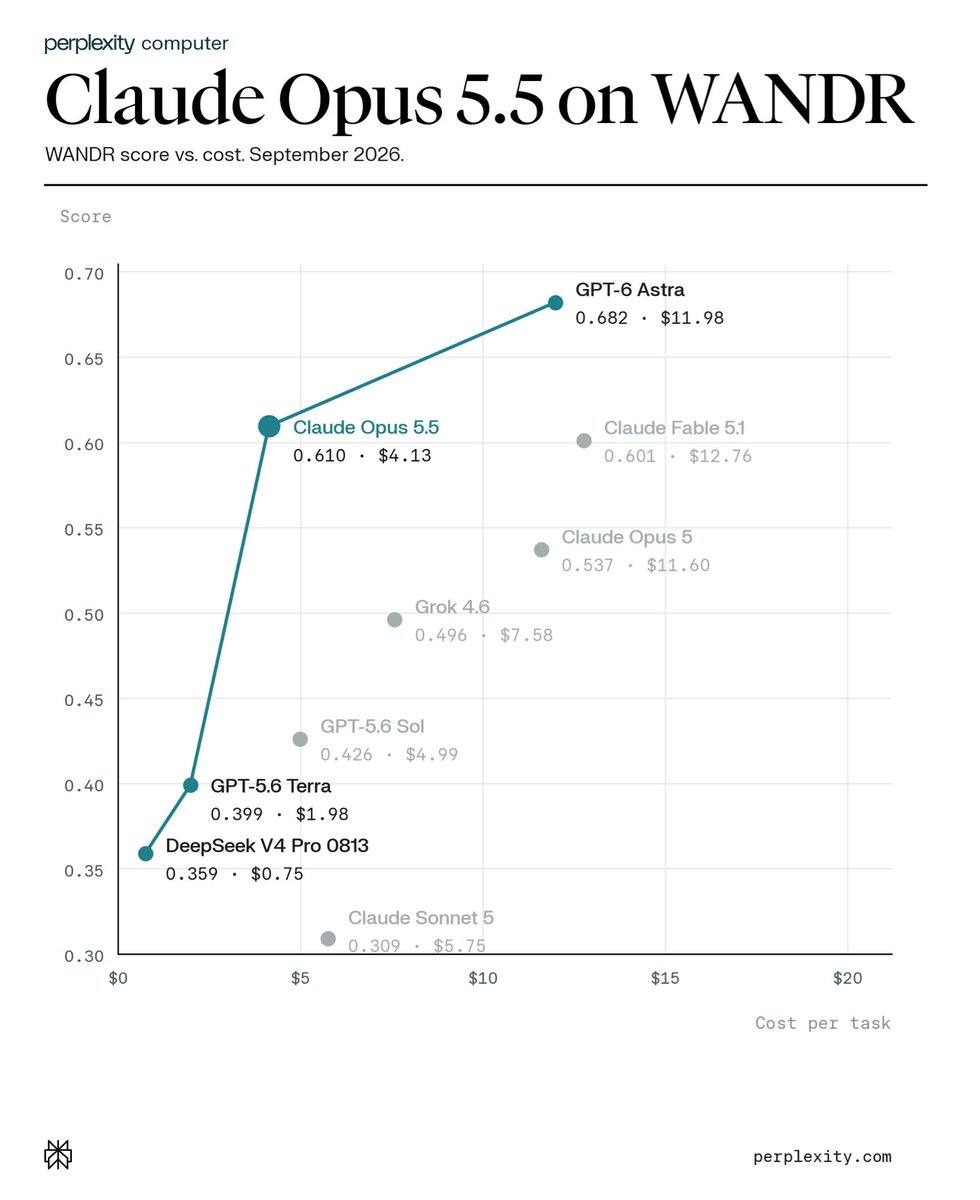
Claude Opus 5.5 is now available as the Standard effort level in Perplexity Computer. On our WANDR benchmark, it scored 0.610 at $4.13 per task, slightly outperforming Claude Fable 5.1 while costing 67.6% less per task.
151521116KView on X ↗
Snorkel AI reposted this
Insight Partners
180,357 followers
Insight Partners is thrilled to share the news of Snorkel AI's $350M Series E announcement, led by Insight and S32 Ventures. Managing Director Lonne Jaffe said of the news: "Snorkel’s research-grade approach to AI data, environments, and measurement is becoming an increasingly important ingredient in building capable and reliable AI systems – and their demonstrated growth at scale reflects that. We’re excited to back Alex and the team as they continue to bring their frontier AI data factory capabilities to longer-running, complex work in high value industries like healthcare, law, and software engineering.” Read more: lnkd.in/giG7X5Xr
192 comments • 3 reposts
This is the beginner one. Lucky Break Chat is built for people who've never tried AI red teaming. Five easy scenarios, a $100 raffle, and no coding or security background needed. You write a sentence. The AI does something it shouldn't. That's it. hubs.ly/Q04y3rm00
Anthropic reposted this
Claude
3,589,592 followers
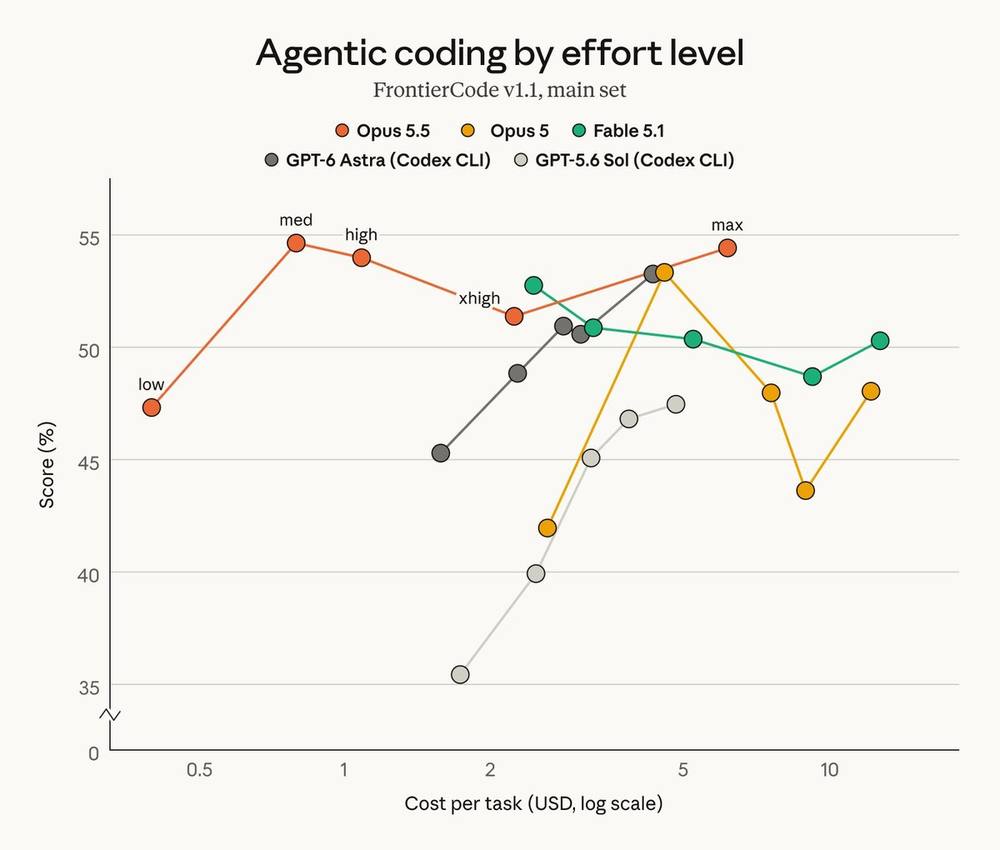
We’re introducing Claude Opus 5.5, the first model in our new Claude 5.5 family. It performs at the level of Claude Fable 5.1 for most tasks, and costs 40% less to run than Opus 5. Opus 5.5 is our first model since we called for pacing the frontier. As with previous models, it was tested by external evaluators before release, including METR and Frontier Design. On our most comprehensive alignment test, it achieves the strongest score to date. It outperforms both Opus 5 and Fable 5.1 on nearly every benchmark we report, leading on agentic coding and real-world knowledge work. It’s also more efficient. Opus 5.5 uses fewer tokens per task at a lower price per token, and generates output more than 30% faster than Opus 5. Opus 5.5 communicates more naturally, addressing some of the most common feedback we heard on Opus 5. It puts the most important information up front and follows the writing rules you give it. Claude Opus 5.5 is available today. We're also raising five-hour limits on Pro, Max, and Team plans, so there’s more room to explore what it can do. Read more: lnkd.in/ed8v38cg
4,188158 comments • 413 reposts
Snorkel AI reposted this
March Capital
15,449 followers
We’re excited to announce March Capital’s investment in Snorkel AI as part of its $350M Series E. As AI systems become more capable and increasingly agentic, the data behind them is becoming more complex, specialized, and consequential. Snorkel AI is building for this next phase. Snorkel combines more than a decade of research in data-centric AI with technology and human expertise to power the data and environments behind frontier AI systems. Today, the company works with leading AI labs and Fortune 500 enterprises on data for model training, evaluation, and real-world AI development. We’re excited to partner with Alexander Ratner and the Snorkel AI team as they continue to scale their agentic data factory. Learn more here: lnkd.in/gvDQwDau And, stay tuned for a conversation with Alex and the March Capital team on MONTY by March Capital.
281 comments • 6 reposts
Snorkel AI reposted this
S32
9,806 followers
S32 is thrilled to co-lead Snorkel AI's latest Series E round. The data landscape for AI model training has rapidly evolved over the last few years. Models have grown in complexity, from single turn responses to multi-step agentic workflows, driving the need for data platforms and agent training environments that can scale with them. We believe Snorkel is best positioned to address this next generation of AI data needs. Their approach to environment generation, task creation, and verification enables them to help top AI labs, builders and enterprises train complex agentic applications across many industries. Their AI engine augments human experts, creating a flywheel that drives efficiency, speed and quality of data, and scalability. The company has scaled revenues over 10x in the last nine months and has shown its ability to move the industry into the next phase of data generation. We've known Alex and team for years, and given their depth of expertise and research background, we believe they are the right team to address this market opportunity. As investors in AI over the past decade, S32 is excited about the critical role Snorkel will play in shaping the future of data for AI. We're look forward to partnering with Snorkel! lnkd.in/d7v9Tfq6
221 comments • 5 reposts
Snorkel AI reposted this
Alexander Ratner
Co-founder and CEO at Snorkel AI
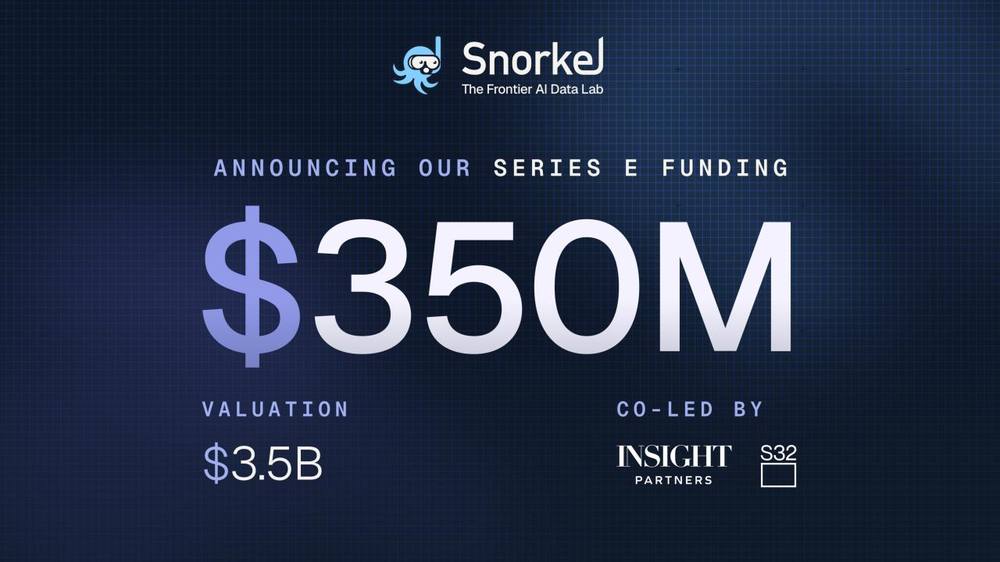
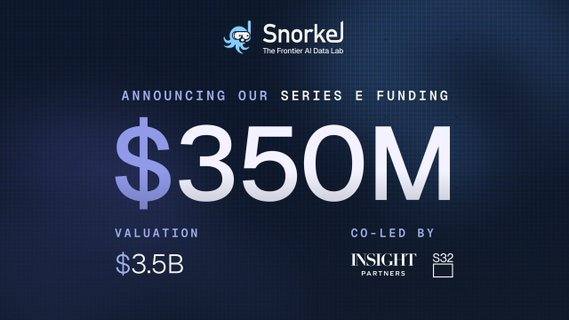
I'm excited to announce Snorkel AI's $350M Series E at $3.5B, led by Insight Partners and S32. We've grown 18x+ in the last 12 months since launching our Data-as-a-Service offering, passing $375M ARRR this week. As AI advances to superhuman capabilities, AI data & environment development must advance with it - and basic staffing and crowdsourcing approaches are not enough. AI progress now requires deep research and technology work that combines human expertise with specialized AI in compounding ways. Snorkel AI is building the RSI data engine and frontier data lab for this next phase. We're honored to have the support of existing investors Addition, Lightspeed, Greylock Partners, GV (Google Ventures), Prosperity7 Ventures, Factory, Wells Fargo, Walden Catalyst Ventures, and new investors Third Point LLC, March Capital, Blumberg Capital, Allegis Capital, Frontline Ventures, and Standard VC. – Snorkel AI started as a research project a decade ago at Stanford Artificial Intelligence Laboratory (SAIL). Our thesis was simple: AI progress would become increasingly data-centric – and therefore data development should be studied as a true research and technology problem, not just a staffing and crowdsourcing one. Today, as AI capabilities verge on superhuman, building the data and environments to safely measure and train AI is becoming too hard for even the smartest human experts to do alone. Only humans and AI agents, collaborating together in compounding ways, can meet the accelerating needs of the frontier, and keep humans in the driver’s seat of AI progress for decades to come. At Snorkel AI, we are building the data lab to define the shape of this new “Data 2.0” frontier, and the new paradigms of human-computer interaction needed to advance it. Our key focus is building the RSI engine for data, where specialized AI models accelerate and improve human expert output, and in turn, scaled human supervision is used to continuously evaluate and improve these models – creating a powerful compounding loop to keep pace with an accelerating RSI frontier. With this round of funding, we are also doubling down on our commitments to support data development for open benchmarking and evaluation (more news here soon!); an increasingly diverse ecosystem of general and specialized intelligence; and a path to safe, well-aligned AI built on robust training and evaluation data. Data development will guide and drive the next stages of AI – and must do so in a human-centric, AI accelerated, open, diverse, and safe way. We are excited to support this mission in the next decade of research ahead at Snorkel AI. More thoughts here: lnkd.in/gWjpQuPE
650109 comments • 172 reposts
The biggest disagreement JSD and I had in this podcast was on the impact of distillation. In our research for Interconnects, @xeophon and I agree that there's no hard evidence that distillation is a massive impact for the Chinese labs. At the same time, the gossip mill in SF has been doubling down on the Chinese labs getting massive gains from distilltion. The argument where distillation is a huge impact is something along the lines of distilled traces go into mid training and make RL work far more easily. My argument, that distillation is a 1-2 month pull ahead in capabilities closer to the frontier, is that Chinese labs already have sufficiently strong models, where this mid-training setup can be done on their own models, and most of the capabilities gains are from scaling RL environment training, which doesn't link cleanly to the distillation data pathway. We feel like the recent RL dashboard from @XiaomiMiMo supports this claim. A lot of it comes down to a gut call on if you can believe it that the Chinese labs are really great at building LLMs, maybe even better than focusing than OpenAI/Ant etc, as their current ambitions are a bit narrower (catching up), rather than transformative products/inventions
Nathan Lambert@natolambert·
New podcast with @datagenproc of @EpochAIResearch digging into the open questions determining the future of frontier AI! We cover: 00:00 Predictions for RSI 18:15 The role of robotics in an AI acceleration 24:20 How far behind are Chinese models? 27:39 Does distillation expla…
▶
Running long-horizon, agentic data projects is the best preparation for building robust enterprise AI apps bc it forces you to build thoughtful expert <> agent interactions and optimize LLM usage. Data companies have a massive advantage in serving the enterprise. We now spend more on LLMs than on headcount. That does not make human operators, and especially experts, less valuable. It actually makes them more productive and more valuable. Purely synthetic data without experts embedded in the authoring process doesn't work, and data companies that don't dig into their own data will ship slop. They won't produce the nuance, realism, or complexity the task demands, and the labs struggle to catch all these issues because they rely on agentic graders that have the same blind spots. But the token spend is significant, and it goes to three places: (1) hybrid synthetic + expert environment / task authoring, (2) rollouts to validate task complexity, and (3) QC on the data. You cannot produce a high-quality long-horizon agentic task without LLMs across all three buckets. We also use agents to automate internal processes, but that is a small fraction of the bill. Any data company telling you the bulk of its LLM spend is internal automation is lying. Producing this data at high quality and reasonable cost comes down to two problems. (1) the expert-agent interaction paradigm - how the expert creates, reviews, interprets, and audits the LLM's outputs (synthetic input files, prompts, rubrics, and so on). Solving this means knowing precisely where agents fail or underperform, designing the interface through which experts validate those outputs, and building the tools that let experts steer the agent going forward. (2) optimizing every QC check for the right tradeoff between cost, quality, and latency. That means constructing complex and diverse eval sets, configuring an agentic system with the right models (often chained prompts, guardrail LLM calls, and deterministic checks), running the eval, then iterating on the harness, prompts, chaining, and model choice until the mix is optimal. Both are now core skills of our SPLs. Enterprise deployments follow the exact same pattern. Understand the workflow and where models fail or underperform, design the user-agent interaction to mitigate those failures, build evals that test the agentic system across the workflow, and optimize the system against those evals. Running data pipelines forces us through this loop hundreds of times a month across a wide range of project types, and we have to build product and infrastructure to do it fast and repeatably. You cannot build an optimal enterprise deployment without these muscles, and the largest data companies have already done it hundreds of times.
ElevenLabs
417,070 followers
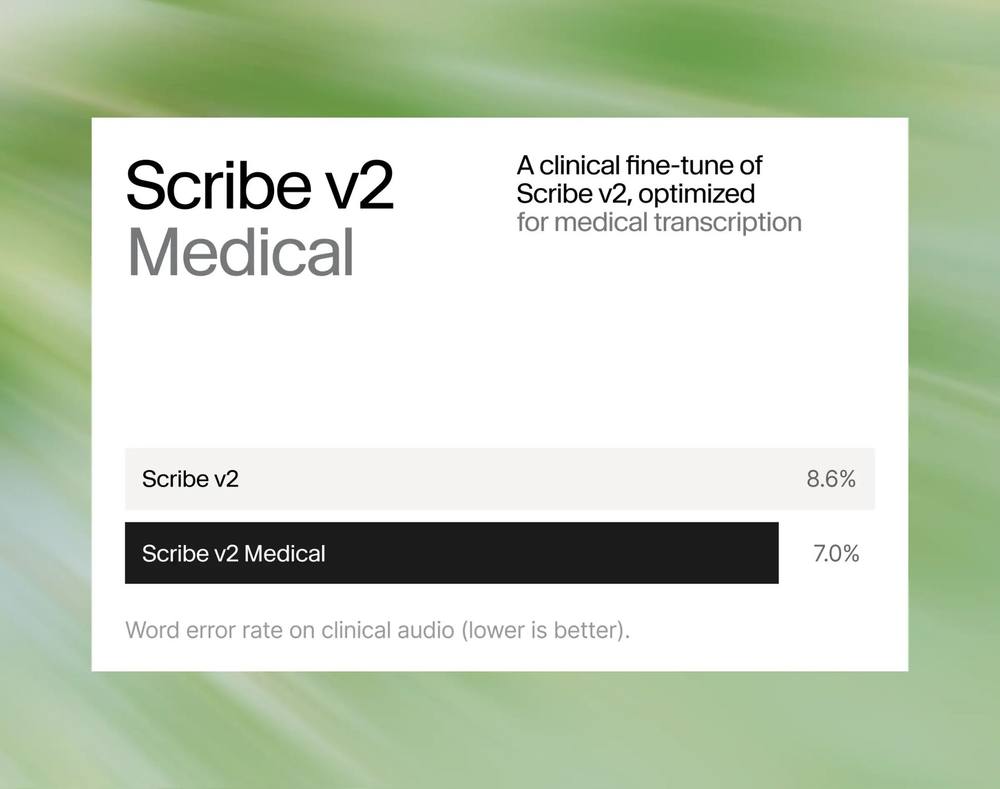
We’re releasing Scribe v2 Medical, our Speech to Text model fine-tuned for clinical audio. Scribe v2 Medical reduces word error rate (WER) on clinical audio by 18% compared to our base Scribe v2 model, improving recognition of medication names, anatomy, and pathology. Clinical speech is one of the hardest tests for transcription. Drug names are long and sound alike (hydroxyzine vs. hydralazine). Dosages, units, anatomy and pathology arrive in rapid sequence. The stakes are higher because a transcription error could end up impacting a patient's care. Scribe v2 Medical is HIPAA-eligible for enterprise customers with Business Associate Agreements in place and Zero Retention Mode (ZRM) enabled. With ZRM enabled for Speech to Text API requests, audio input and text output are deleted immediately after each request completes. ElevenLabs retains neither, and your application receives the full API response and controls how transcripts are retained. Teams building ambient documentation, dictation, and clinical voice agents can use it today: lnkd.in/ey8XBmfh
1134 comments • 15 reposts
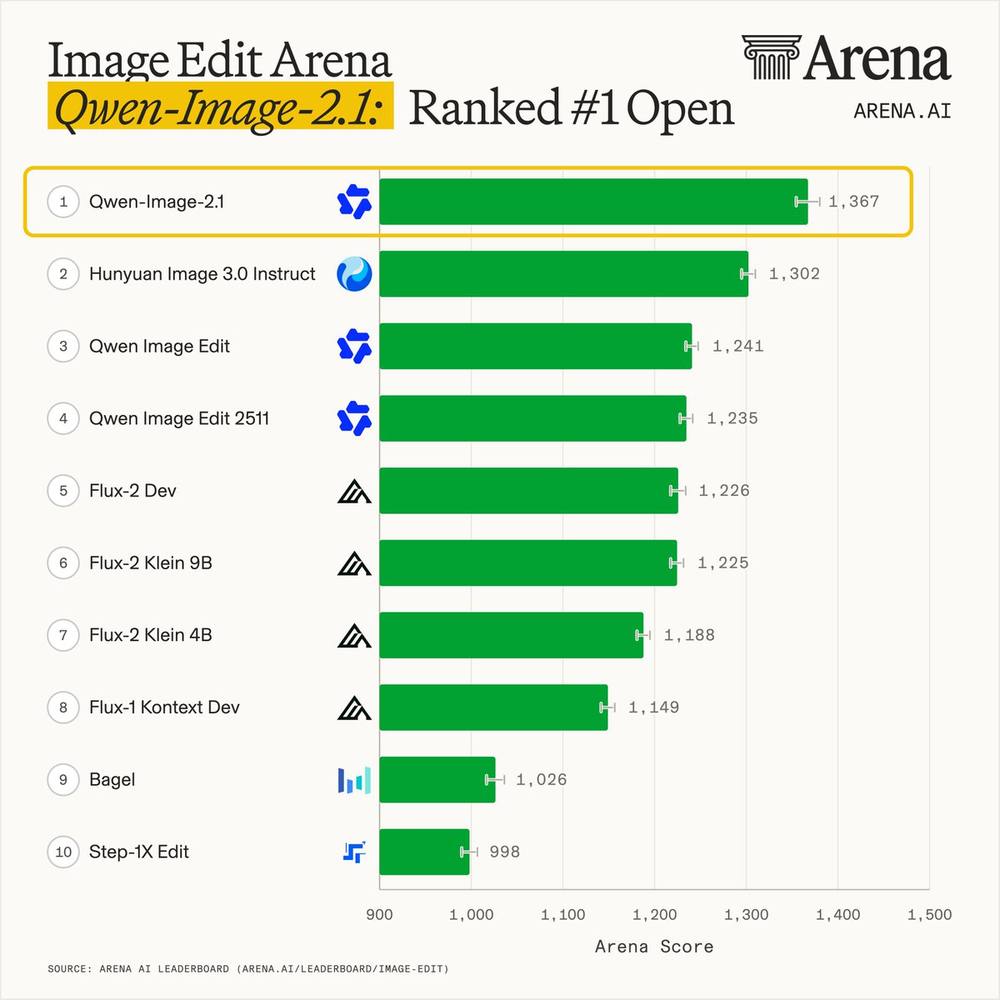
Qwen-Image-2.1 by @Alibaba_Qwen just landed as the #1 open source model in the Image Edit Arena and Text-to-Image Arena! With 1367 pts in the Image Edit Arena, Qwen-Image-2.1 took the #1 spot among open. It landed #16 overall, just 3 pts from GPT-Image-1.5-high-fidelity at #15. See the leaderboard for the Text-to-Image arena below. Congrats to the @Alibaba_Qwen team on this contribution to the open source ecosystem!
Qwen@Alibaba_Qwen·
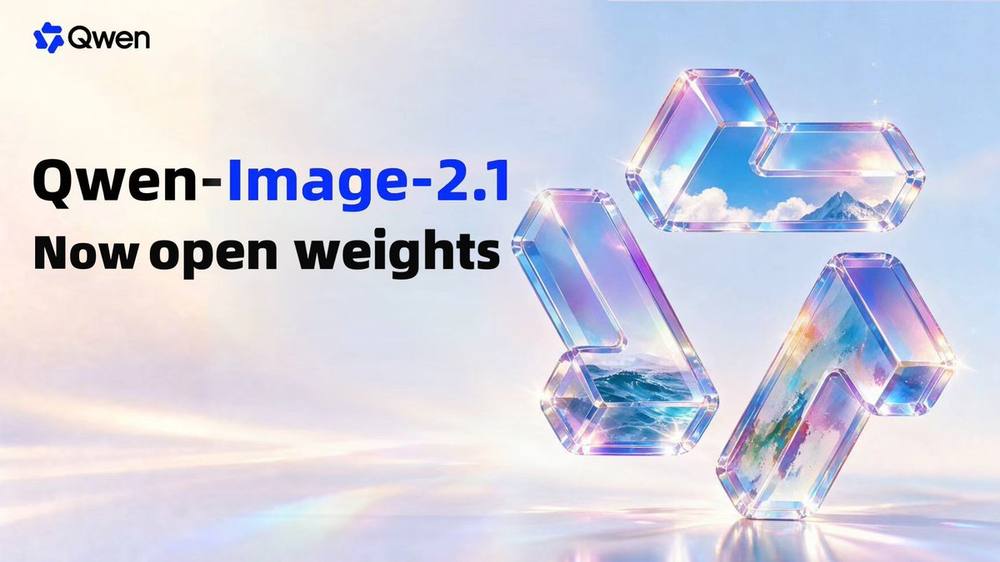
Meet Qwen-Image-2.1, the most balanced and cost-effective image generation model in the Qwen-Image series! Now open weights! 🎨 A unified model for both generation and editing, delivering top-tier quality in a lightweight package. Highlights: 👀 - Compact & exceptionally fast…
201824423KView on X ↗
I'm excited to announce @SnorkelAI's $350M Series E at $3.5B, led by @insightpartners and @S32_VC. We've grown 18x+ in the last 12 months since launching our Data-as-a-Service offering, passing $375M ARRR this week. As AI advances to superhuman capabilities, AI data & environment development must advance with it - and basic staffing and crowdsourcing approaches are not enough. AI progress now requires deep research and technology work that combines human expertise with specialized AI in compounding ways. @SnorkelAI is building the RSI data engine and frontier data lab for this next phase. We're honored to have the support of existing investors Addition, @lightspeedvp, @GreylockVC, @GVteam, P7, Factory, @WellsFargo, Walden Catalyst Ventures, and new investors @ThirdPointLLC, @MarchCPs, @BlumbergCapital, @AllegisCapital, @Frontlinevc, and @standard_vc. – @SnorkelAI started as a research project a decade ago at @StanfordAILab. Our thesis was simple: AI progress would become increasingly data-centric – and therefore data development should be studied as a true research and technology problem, not just a staffing and crowdsourcing one. Today, as AI capabilities verge on superhuman, building the data and environments to safely measure and train AI is becoming too hard for even the smartest human experts to do alone. Only humans and AI agents, collaborating together in compounding ways, can meet the accelerating needs of the frontier, and keep humans in the driver’s seat of AI progress for decades to come. At @SnorkelAI, we are building the data lab to define the shape of this new “Data 2.0” frontier, and the new paradigms of human-computer interaction needed to advance it. Our key focus is building the RSI engine for data, where specialized AI models accelerate and improve human expert output, and in turn, scaled human supervision is used to continuously evaluate and improve these models – creating a powerful compounding loop to keep pace with an accelerating RSI frontier. With this round of funding, we are also doubling down on our commitments to support data development for open benchmarking and evaluation (more news here soon!); an increasingly diverse ecosystem of general and specialized intelligence; and a path to safe, well-aligned AI built on robust training and evaluation data. Data development will guide and drive the next stages of AI – and must do so in a human-centric, AI accelerated, open, diverse, and safe way. We are excited to support this mission in the next decade of research ahead at @SnorkelAI. More thoughts here: snorkel.ai/blog/data-2-0-and-the…
5313326928KView on X ↗
Cristóbal Valenzuela
Co-Founder & Co-CEO, Runway
Who could we hire to help us do that? One of the questions I’ve been asked most often over the last five years finally has an answer. Introducing DIFFUSE: All of the world's top Al talent. All in one place.
231 reposts
Today we're launching DIFFUSE: a platform for agencies, brands and studios to search for, connect with and hire AI-native talent. There's a lot of worry around AI displacing creatives but the reality we keep seeing is different: an entirely new creative workforce is emerging, and demand for it is accelerating. DIFFUSE connects that talent with this new landscape of opportunities. Register and learn more at the link below.
163317921KView on X ↗