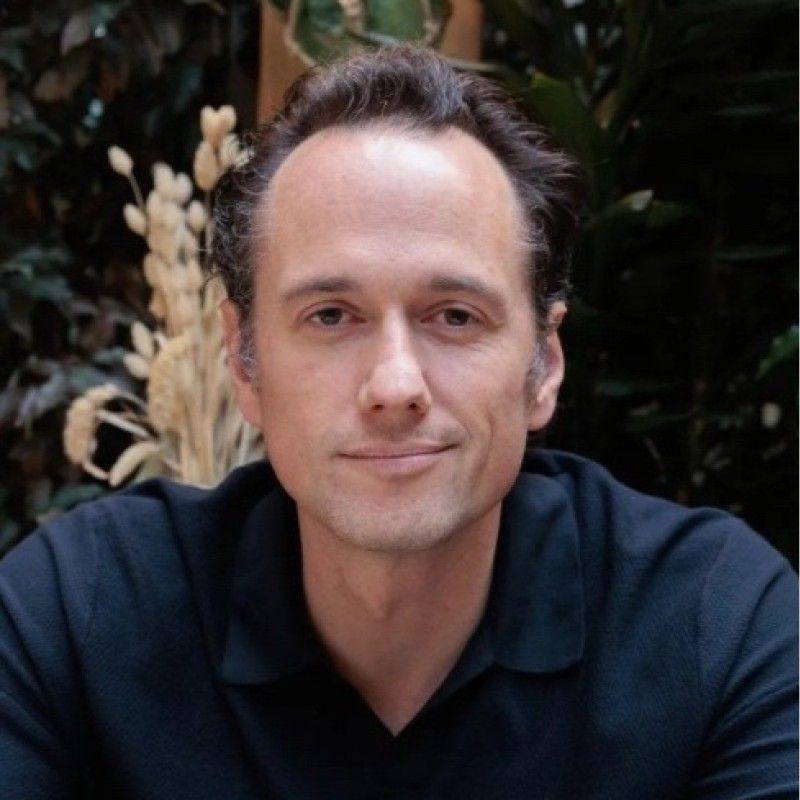
Former McKinsey senior partner who ran QuantumBlack Labs (about 1,000 engineers). He became Invisible's CEO in January 2025, has since raised $100M+ at a $2B+ valuation, bought WeCP and repositioned Invisible as an enterprise AI platform on top of its training-data business.
high confidenceAt Invisible Technologies since 2025Updated 2026-09-19
Background
He studied at Princeton and Wharton and made senior partner at McKinsey, where he was Global Head of QuantumBlack Labs, its AI software and R&D arm. He succeeded Benjamin Plummer as Invisible's CEO on Jan 21 2025, with founder Francis Pedraza becoming executive chairman.
What they run now
Two tracks: the RL Data Lab and expert marketplace selling training and eval data to model builders, and Meridial, a modular enterprise platform (data, workflows, expert marketplace, evaluation, agents). WeCP is being folded in to vet experts faster.
Career
2025 – presentCEO, Invisible Technologies
2025Senior Partner; Global Head of QuantumBlack Labs, McKinsey & Company
—Princeton University
—Wharton School
On the record
Humans in data · 2026-01
Humans will stay involved in AI data creation for decades (per Business Insider headline). source
Enterprise AI failure · 2025-01
Fewer than 10% of AI models reach production because enterprises lack evaluation and operational know-how. source
Governance · 2026-01
Next phase of AI adoption will be won on execution, governance and trust. source
Integration · 2026-01
Enterprise AI works through integration and forward-deployed engineers redesigning workflows, not isolated pilots. source
Recent posts
7 posts archived · most engaged first, then the latest
Chief Executive Officer at Invisible Technologies, Formerly Senior Partner and Global Leader of QuantumBlack Labs at McKinsey & Company
•
Today marks one year since I joined Invisible Technologies as CEO
When I joined, we were intentionally quiet. A company doing serious work behind the scenes for some of the most sophisticated companies in the AI space, but largely unknown.
That's changed.
In the last 12 months we:
+ Raised $100M to scale our AI software platform
+ Joined the World Economic Forum's Unicorn Innovator community
+ Hired a new Platform CTO and 4 Field CTOs, and 3xed the size of our product and engineering team to 200+
+ Launched our end-to-end AI platform suite of 5 interoperable modules: Neuron, the data platform; Atomic, the process builder; Meridial, the expert marketplace; Synapse, the evaluations layer; and Axon, the agentic layer. The combined power of these modules enable us to serve all of our client needs across AI Training and Enterprise with a single unified platform
+ Brought in elite senior enterprise leadership in each of our core verticals: (i) Food & Beverage, (ii) Asset Management/PE, (iii) Banking & Insurance, (iv) Healthcare, (v) Public Sector, (vi) Oil & Gas, (viii) Industrial Manufacturing, (ix) Sports, (x) Agriculture, (xi) Contact Centers.
+ Shifted from fully remote to opening offices in New York, San Francisco, Washington D.C., London, and Warsaw
+ Placed on the Deloitte Fast 500
+ Completed a full company and marketing rebrand
+ Secured over 100 earned media placements, from Bloomberg Media to Business Insider to The Information to 20VC with Harry Stebbings and Moonshots with Peter H. Diamandis
We brought the full global team together in Punta Cana. We expanded our bench of Forward-Deployed Engineers committed to sitting alongside our clients and solving their hardest problems. We deepened our partnerships with 80% of foundation model providers on evals and training.
And we shipped real AI in production:
→ Charlotte Hornets: AI-powered draft analytics that helped deliver a summer league MVP and championship
→ SAIC + U.S. Navy: Real-time intelligence for unmanned submarine drones
→ LifeSpan: A unified Patient 360 AI backbone for precision medicine
→ SwissGear: Unified 750 data sources in one week to improve demand forecasting
We showed up at Davos this week. We showed up at FII Institute. We showed up at Bloomberg New Economy. We showed up at Founders Forum Group. We showed up at NeurIPS. We showed up at Abundance360
Thank you Francis Pedraza for trusting me to lead what you created, you are a great friend and shaped an extraordinary team and company.
Its been a busy year, but also the most fun one I can remember.
Invisible is no longer invisible.
And we're just getting started.
Grateful to the Invisible team, our clients, and our partners for an incredible first year. The best is still ahead.
Chief Executive Officer at Invisible Technologies, Formerly Senior Partner and Global Leader of QuantumBlack Labs at McKinsey & Company
•
Enterprises are spending vast sums on AI, few are making it work. We raised $100M to change that.
When I joined Invisible Technologies as CEO in January, I was drawn to the opportunity to create the next generation of AI infrastructure for the enterprise. It’s been a busy eight months.
Today, I’m excited to share that we’ve secured $100 million in growth funding, led by Vanara Capital. This supercharges our mission to transform how enterprises build, deploy, and drive value from AI.
Most of the world’s software is old. Legacy systems, messy data, fragmented workflows. That’s why so many enterprises are still struggling to get AI into production and prove ROI.
This round is about scaling our impact. We’re expanding our AI software platform, which now includes five modular engines to support end‑to‑end AI workflows.
With new leadership onboard—like Kit Colbert, former CTO of VMWare, who joined as Platform CTO, a strengthened global technical leadership team of Field CTOs Aaron Bawcom, Alexius Wronka, Junaid Syed, and senior enterprise experience including Benjamin Samuels, former CRO of WeWork, and most recently Sharon Woods, who brings decades of leadership across the White House, Pentagon, and Defense Agencies—we’re accelerating innovation for clients across North America and EMEA.
A big thank you to our new partners Vanara Capital, Princeville Capital, HOF Capital, Freestyle Capital, Rocketeer Management, and Tallwoods Capital, and all of our existing investor participants Acrew Capital, Greycroft, BACKED VC, BY Venture Partners, and Deepwater Asset Management.
And an even bigger thank you to our entire team of builders for their commitment, ownership, and for powering us to reach this milestone.
Welcoming Hayden Lekacz (Vanara) onto our board will infuse fresh strategic insight as we scale.
We’re already making AI work:
Our AI draft analytics helped deliver the Charlotte Hornets summer league MVP and championship in a matter of weeks.
With SAIC and Vatn Systems, Invisible supported the companies in a joint exercise with the U.S. Navy of automated performance analysis of Unmanned Underwater Vehicles and their sensors.
SWISSGEAR, the luggage brand, can now accurately forecast inventory to maximize sales.
Consumer.
Sports.
Government.
Asset Management.
Healthcare.
And many more to come….
We’re defining the next decade of how the enterprise runs.
We’re making AI work.
This is just the beginning! Check out our coverage in Bloomberg published this morning – link in the comments.
Chief Executive Officer at Invisible Technologies, Formerly Senior Partner and Global Leader of QuantumBlack Labs at McKinsey & Company
•
Invisible Technologies now has a Wikipedia page.
Founded in 2015, Invisible achieved rapid growth with the emergence of GenAI, as one of the early innovators on the frontier of AI Training. Then $100 million raised in 2025. Over the last 18 months our AI infrastructure platform has now scaled across Asset Management, Healthcare, Consumer/Retail, Financial Services, and other sectors, with a broad mix of clients ranging from Thompson Reuters to GrubHub.
A decade of focused effort, now recognized publicly.
When I joined as CEO in January 2025, we operated quietly. We were building critical infrastructure for some of the most sophisticated companies in the AI space, largely unknown outside of our clients.
That's changed. We've shipped AI in production across sports analytics, healthcare patient intelligence, and demand forecasting. We've opened offices in New York, San Francisco, Washington D.C., London, and Warsaw. Our product and engineering team has grown to over 200.
The Wikipedia page is a small milestone, but it signifies how far this team has come.
Grateful to Francis Pedraza for his foundational work, and to the entire Invisible team for making this growth possible.
Chief Executive Officer at Invisible Technologies, Formerly Senior Partner and Global Leader of QuantumBlack Labs at McKinsey & Company
•
I keep seeing the same pattern. Most enterprise AI projects fail because they add automation to the old way of working, and they end up with a faster horse not a car, and no ROI.
The model isn't the bottleneck. The workflow redesign is.
A company takes an existing process, like how they process insurance claims or onboard new hires, and bolts a model on top of it. They call it AI transformation. Nothing meaningfully changes, everyone still does the same work with 5% more free time.
The real question is different. It's not "how do we make this process faster with AI?" It's "what should this workflow look like if we designed it from scratch in an AI-native context?"
That shift sounds simple, but almost no one does it because it requires three things most enterprises don't have in place.
First, harmonized data. The average enterprise runs 10+ ERP systems alongside separate HR databases, CRMs, and more. The data across those systems is fragmented, inconsistent, and often untrustworthy. AI can't act reliably on unreliable inputs. Only 7% of enterprises say their data is completely AI-ready, according to Cloudera and HBR. Meanwhile 97% have active AI initiatives. That gap is where most projects go to die.
Second, workflows redesigned for AI natively. Not the old process with a model layered on top. A fundamentally different way of working that takes advantage of what AI actually does well.
Third, and this is the hardest one, a line owner with accountability for an operational KPI. Not an IT team running a pilot. A Business Unit leader who owns a number and is responsible for whether AI moves it.
That third element is the biggest barrier I see right now. It explains why individual productivity gains from AI run 15 to 20% while company-level gains sit at 1.8 to 3%. The gains are real at the individual level, but they don't compound across the organization because no one owns the outcome at the business level.
80% of enterprise AI initiatives fail to deliver value. 60% are abandoned due to lack of AI-ready data. Less than half make it to production. These numbers will not change until companies stop treating AI as a technology project and start treating it as an operating model change.
The model layer is already good enough, and cost of usage has never been cheaper. But the production system around deployment is what determines whether a workflow is transformed and creates economics value, and that is we are building at Invisible Technologies.
And thanks to the NYSE for having me on to discuss this.
Chief Executive Officer at Invisible Technologies, Formerly Senior Partner and Global Leader of QuantumBlack Labs at McKinsey & Company
•
The AI fear narrative is not just wrong, it's slowing down adoption across a range of areas where AI would help society (healthcare administration, customer service, infrastructure development).
I dug into this during my recent video interview with the team at the New York Stock Exchange (NYSE) at the Uncharted summit.
The core claim behind this narrative is that work is finite. If AI can do a task, that task disappears and so does the job. This is the lump of labor fallacy, and it has been wrong every time it has been applied to a new technology.
What actually happens is closer to Jevons Paradox. When technology lowers the unit cost of work, demand for that work doesn't shrink. It explodes.
Consider lawyers. In the 1980s, when legal work started to digitize, there were roughly ~570,000 lawyers in the United States. The fear at the time was that technology would eliminate legal jobs by making research and document review faster and cheaper. Instead, as legal work became more accessible and the economy grew more complex, demand surged. Today there are 1.4 million lawyers in the US. The technology that was supposed to replace them nearly tripled the profession.
AI is following the same pattern. Lower cost of building and operating doesn't eliminate industries. It creates new ones, new workflows, new roles, and new categories of work that didn't exist before the cost dropped.
The World Economic Forum projects 92 million existing jobs displaced alongside 170 million new jobs created globally by 2030. That is a net gain of 78 million jobs. This mirrors the technology displacement and creation cycles we have seen over the last 100 years.
The real damage of the fear narrative is not that it's intellectually wrong. It's that it scares enterprises away from adoption. Leaders and teams hear "AI will eliminate jobs" and so don’t engage, when the evidence shows that the companies that move now will be the ones scaling faster, capturing more demand, and creating new roles/hiring.
When technology makes work cheaper, the world doesn't do less. It builds more. And Invisible Technologies is focused on infrastructure to enable that building.
Thanks to Ashley Mastronardi for the thoughtful interview and the great discussion!
Chief Executive Officer at Invisible Technologies, Formerly Senior Partner and Global Leader of QuantumBlack Labs at McKinsey & Company
•
Mary Meeker was called the "Queen of the Net" by Barron’s in the 1990s, for her “optimistic” predictions about the future during the dot-com era. After the crash, PBS described her as emblematic of "the intellectual hollowness of the Internet bubble's headiest days."
Decades later, her predictions look different, and provide an interesting parallel for the evolution of AI. The optimism that comes with any new technology can often create elements of a bubble, but “the days are long and the decades are short”, and 𝐨𝐯𝐞𝐫 𝐭𝐡𝐞 𝐩𝐚𝐬𝐭 𝟑𝟎 𝐲𝐞𝐚𝐫𝐬 𝐞𝐯𝐞𝐧 𝐌𝐞𝐞𝐤𝐞𝐫’𝐬 𝐦𝐨𝐬𝐭 𝐚𝐠𝐠𝐫𝐞𝐬𝐬𝐢𝐯𝐞 𝐚𝐧𝐝 𝐨𝐮𝐭𝐥𝐚𝐧𝐝𝐢𝐬𝐡 𝐩𝐫𝐞𝐝𝐢𝐜𝐭𝐢𝐨𝐧𝐬 𝐟𝐞𝐥𝐥 𝐬𝐡𝐨𝐫𝐭 𝐨𝐟 𝐫𝐞𝐚𝐥𝐢𝐭𝐲:
In 1995, she projected 7% global internet penetration by 2010. The actual figure was 29%
She predicted $36 billion in new internet business revenue by 2000. The actual figure exceeded $171 billion in 1999
She predicted online advertising budgets would increase, but not that 63% of total media spend would eventually be allocated to online
A recent Bloomberg analysis of 86 predictions from Meeker's Internet Trends Reports between 1995 and 1997 found the same pattern. The vast majority proved directionally correct, and often modest in hindsight.
But perhaps even more interesting is where Meeker was wrong: Who she thought would be the winners of the internet era. In 1997, she foresaw the multibillion-dollar online retail market, but predicted firms like Barnes & Noble and CUC would dominate it. She also saw Netscape and Microsoft as the long-term browser winners.
Meeker believed current scaled incumbents would adapt and win as adoption accelerated. But in the end it was digitally-native new entrants that captured most of the growth.
I see the same dynamic playing out with AI today.
Digitally-native companies use AI as an operating system, and they are operating on cleanly architected data and modern infrastructure. They can move, adapt, and build much faster.
Larger existing Enterprises have several decades of tech debt to work through to scale AI to production: 70% of software in the US is over 20 years old, with extremely fragmented data across regions/business lines. 80%+ of Enterprise AI initiatives fail to deliver value, and 60% will be abandoned through 2026 due to data readiness challenges.
But those failures are infrastructure problems, not technology limitations.
The companies investing in data harmonization, workflow redesign, and governance are building the foundation for what comes next. That’s what we’re focused on at Invisible Technologies. The tech works, the adoption is real, and long-term impact will exceed current projections. It will just take time, the same pattern Meeker saw with the internet.
Skeptics will be right about short-term volatility in markets and valuations. They'll be wrong about the direction.
What is your perspective on where AI adoption will be in 10 years?
Article link in comments 👇
Moderate. Invisible buys expert time for labs and is investing in expert validation (WeCP), but its public domains are STEM, finance, healthcare and coding. Creative and visual domains are not visible. He is a potential channel partner if a taste specialist can plug expert raters into a larger vendor's lab contracts.
How to reach
Speculation: he responds to enterprise and consulting framing (ROI, governance, evaluation rigour). The practical entry point is the RL Data Lab co-heads rather than the CEO.
What we could not establish
2025/2026 revenue
WEF bio says $130M raised under him; only $100M round confirmed
 Miju Labs