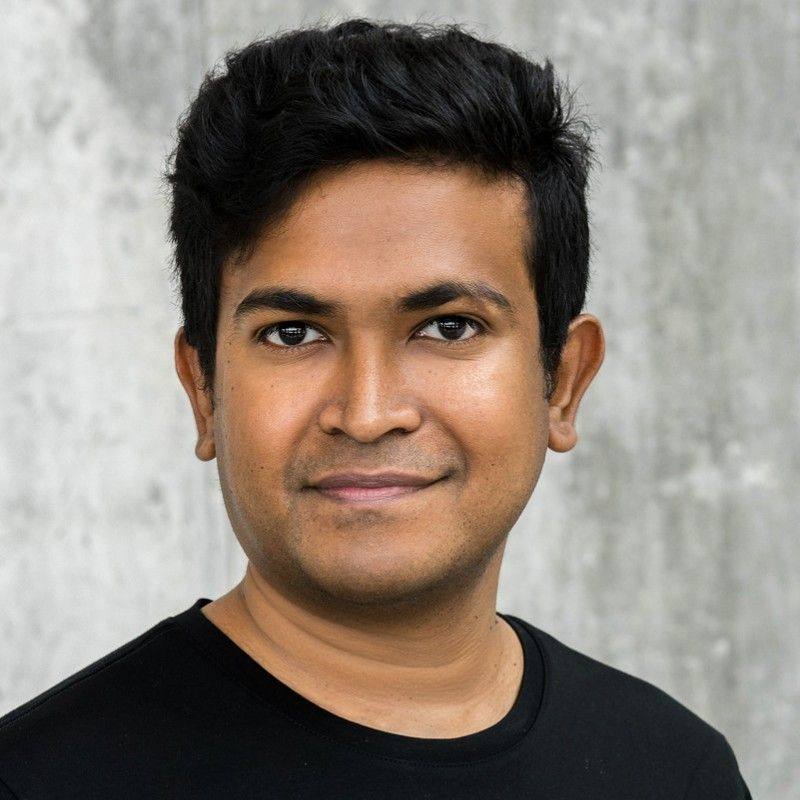
Founder-CEO of Turing. He took a remote-developer staffing marketplace and repositioned it as a 'research accelerator' for frontier labs. He is the loudest voice arguing that commodity data labelling is dead and that expert, workflow-grounded data and RL environments are what labs now buy.
high confidencePortola Valley / Palo Alto, CAAt Turing since 2018Updated 2026-09-19
Background
Grew up in India and did a Stanford CS master's focused on machine learning and search. He met co-founder Vijay Krishnan at Stanford. He interned in Yahoo's search-relevance group and worked on ranking at Powerset, which Microsoft later acquired.
In 2008 he co-founded Rover, an ML content-discovery app that Revcontent acquired. He co-founded Turing in 2018 around AI-driven sourcing and vetting of remote engineers. When LLM labs needed large volumes of coding data, Turing's vetted-developer pool became a data supply chain.
What they run now
Positioning Turing above the commodity tier. He is driving Turing Frontier (US-based elite domain experts across STEM, finance, legal and medicine, launched Apr 2026), RL environments and evals for labs, and a parallel enterprise AI deployment business. In mid-2026 he rebuilt the leadership bench with a President/CRO (Bordoli) and a research-grade CTO (Kamar).
Career
2018 – presentCo-founder & CEO, Turing
2008Co-founder, Rover (acq. by Revcontent)
—Intern, search relevance, Yahoo
—Ranking / search relevance, Powerset (acq. by Microsoft)
—Stanford University, MS Computer Science (ML / search)
On the record
Data labelling is over · 2025-12
Basic image/text labelling is obsolete. Vendors must become 'research accelerators' that build RL environments and recruit domain experts. He was quoted: "The era of data-labeling companies is over." source
Revenue quality in the sector · 2025-12
He questioned whether rivals report GMV as revenue. source
Knowledge work automation · 2025-12
He predicts that the vast majority of knowledge work (he says 99%) will be automated within about a decade and frames it as a ~$30T market. source
Role of experts · 2026-04
He says the expert's job is shifting from doing the work to training models to do it and then verifying their output. source
Pace of AI · 2025-10
He expects steady, continuous progress rather than a rapid takeoff. He says internet pre-training data is used up, so proprietary data is the moat. source
Recent posts
5 posts archived · most engaged first, then the latest
Turing is doubling down on its AI and engineering roots.
We're scaling our research team. Reporting to me.
The superintelligence race runs on three pillars.
Frontier labs advance algorithmic research.
NVIDIA advances compute infrastructure.
Turing advances data infrastructure.
We work with every frontier lab on the three capabilities that matter most:
1/ Software engineering, to accelerate AI research and product development
2/ Enterprise agents, to accelerate knowledge work across all industry verticals
3/ Scientific reasoning, to accelerate discovery
The research team will be publishing at NeurIPS, ICML, and ICLR, and contributing datasets and tools to the open source community.
Our work is grounded in real enterprise deployments, building end-to-end AI systems inside Fortune 500 companies in financial services and life sciences. That's what keeps the research honest.
We're building toward a future where AI accelerates its own progress, makes new scientific discoveries, and adds points to global GDP as knowledge work compounds.
If you'd like to join Turing Research, DM me or jonathan.s@turing.com. Tell us what you're exceptional at and what you'd be excited to work on.
Turing's focus right now:
1. Automate AI research
2. Automate engineering
3. Automate knowledge work
4. Automate scientific discovery
The models come from frontier labs. The training signal comes from us. Data, evals, and RL environments built from real workflows. Hard enough that today's best models still fail.
AI research sits at the top for a reason. Automate that, and everything below it compounds.
If you're training models toward any of these four and need environments that don't saturate, DM me.
When starting Turing, I thought about human capability in three levels.
Level 1: Task scope. You own the task's success. You're given a task. You execute it.
Level 2: Objective scope. You own the objective's success. You're given an objective. You figure out the tasks. You iterate in task space.
Level 3: Company scope. You own the company's success. You're given the mission. You propose the objectives. You iterate in objective space.
The best ICs I've hired operate at objective scope and above.
The best managers I've hired operate at company scope.
The same ladder maps to AI today.
Most of what we call recursive self-improvement is still objective scope. The objective is fixed: minimize pre-training loss, maximize performance on a benchmark or a private eval. The model iterates in task space against it.
The next level of AI progress comes when models can pick the right objectives to hillclimb.
That's company scope. And it carries real safety and alignment risks. A model optimizing an objective you gave it and a model choosing its own objectives are very different things to align.
What's the analog to company scope for ASI?
To get to ASI we likely need auto-meta-research, not just auto-research.
Auto-research hill climbs within the current recipe. Minimize pretraining loss, maximize post-training evals.
Auto-meta-research defines new objectives. An outer loop that searches across paradigms. Outside deep learning, maybe even outside gradient descent. Not just scaling transformers + RL.
The inner loop optimizes the recipe. The outer loop questions the recipe.
A lesson from the DeepSeek-V4.1 technical report:
"...the marginal return of engineering the data and environment pipeline substantially exceeds that of algorithmic novelty in post-training."
My 2 cents. The interesting part isn't data > algorithms. It's that the distinction is collapsing. Look at what their pipeline actually does: synthesizes verifiable tasks with reward signals, builds interactive agent environments, calibrates difficulty and curriculum at scale. That's not just data collection. That's research. Some of the highest leverage research is happening in the data + environment pipeline.
We are in the era of research AND scaling up.
The current recipe doesn't need to work forever. It only needs to help us find the next S curve.
Investor/advisor to StartX (Stanford accelerator), per WestBridge profile
Why it matters here
Mostly indirect relevance. Turing's expert pipeline is coding and STEM first, and the Turing Frontier launch lists no creative or design domains. That leaves the gap Julian is targeting. Siddharth's 'research accelerator' framing (expert data plus environments plus evals) is the pitch every lab now hears, so a taste specialist needs to be legible in those terms. He is also a possible future buyer or partner if Turing wants a creative vertical it does not want to build itself (speculation).
How to reach
He is very active on X (@jonsidd) and posts hiring calls and public invitations to DM him. In the past he has published his work email for hiring. A short, concrete note on a gap Turing Frontier does not cover (visual/design judgement data, with evidence of lab demand) is likelier to land than a generic intro (speculation). Ask how Turing decides which expert verticals to build and which to partner on.
What we could not establish
No audited 2025/2026 revenue; the ~$350M ARR figure comes from his own 20VC bio.
WestBridge profile lists him as a Quora board member; not verified elsewhere, so it is omitted from investments.
 Miju Labs